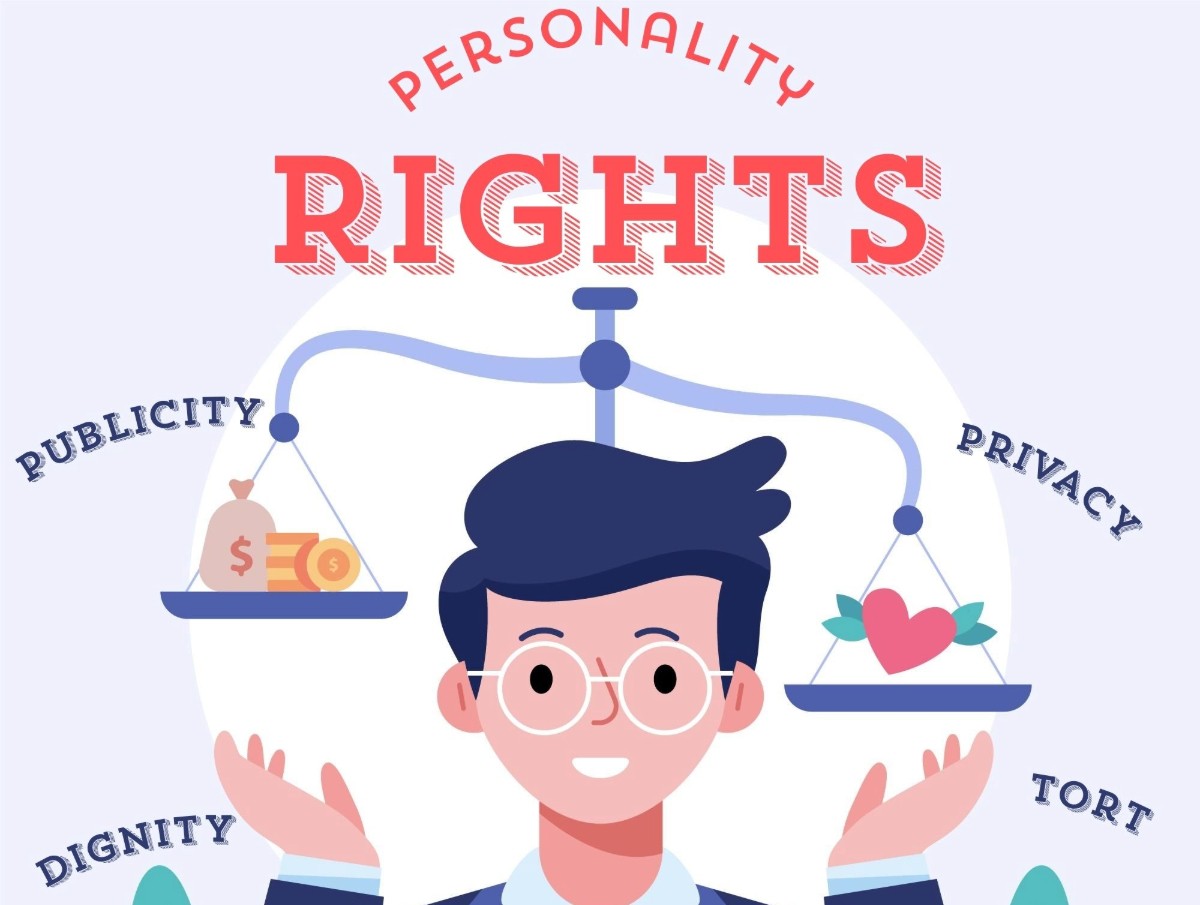
Drafting Credit: Divya Telang, Research Associate
Image credits: via Magnific (edited with Canva)
Historical Origin: How Personality Rights Were Born
What does it mean to own your own face? Your name? The sound of your voice on a recording you never consented to? These feel-like questions born of the internet age, of deepfakes, and Artificial Intelligence [“AI”]. But the legal argument behind them is older than the invention of automobiles. It begins in the time newspapers and photography grew in prominence, with a simple and still-unresolved problem: when someone uses your identity without asking, what exactly have they taken from you?
1. The Inviolate Personality
For most of recorded history, the law protected what it could see and measure. It protected land from trespassers, goods from thieves, reputation from lies. What it could not easily protect was something more intangible – that a person’s persona belongs to them. Your ‘self’, your image, your private life, belonged to you and could not be put to someone else’s use without your consent.
By the late nineteenth century, two developments were making that gap impossible to ignore. The first was photography, which was cheap, quick, and suddenly capable of capturing a person’s likeness and reproducing it at scale. The second was print- newspapers and magazines which came with a large number of readers. It was these twin pressures that prompted two lawyers from the U.S., Samuel D. Warren and Louis D. Brandeis put forth an argument: that the law had always, in its protection of property and of persons, been circling around a deeper value without outrightly naming it, known as the “inviolate personality”.1 They called it- “the right to be let alone”.2
The lawyers traced its outlines through existing legal doctrines such as copyright in unpublished letters, equitable relief for breach of confidence, the common law of defamation, and argued that each of these, at bottom, was protecting something the law had never stated directly, that is, a person’s right to control the disclosure of their own inner life. The problem was that technology had outrun those older tools. Photographs could not be copyrighted by their subjects. Defamation required a false statement. Breach of confidence required a prior relationship. None of these adequately addressed the photographer who sold your portrait without asking, or the gossip column that exposed your private correspondence to a mass readership.
What Warren and Brandeis proposed, in effect, was that the law recognise a new tort, a civil wrong that could be committed against someone simply by exposing private facts about their life without consent, regardless of whether any property was stolen or any falsehood told.
2. Four Boxes for One Problem
It was not until 1960 that a law professor named William Prosser attempted a systematic account of what privacy law had actually become in the decades since. Prosser surveyed hundreds of court decisions and concluded that the courts had, without quite coordinating with each other, developed four distinct types of privacy tort:3
- Invasion of Privacy: physically or electronically invading someone’s private sphere
- Public disclosure of private facts: broadcasting true information that a reasonable person would find deeply objectionable to have made public
- False light: putting someone in a misleadingly unflattering public portrayal
- Appropriation of likeness: using someone’s identity for one’s own gain without permission.
The first three are recognisably about dignity and peace of mind, they address the harm of being exposed against your will. The fourth is categorically different. It is not really about embarrassment or intrusion at all. It is about gain. It means your name and face have commercial value, and that value is yours, not the person who puts your picture on a product without asking. Prosser’s categorisation became a treatise of American privacy tort law.4
But it also contained a tension that would drive decades of legal development. The harm the fourth category addressed was fundamentally economic, while the framework it sat inside was built around personal dignity.
3. The Chewing Gum Case
Haelan Laboratories and Topps Chewing Gum were rivals in the business of packaging baseball trading cards with bubble gum. Haelan had signed exclusive agreements with several prominent players, giving the company sole rights to reproduce their photographs on its cards. Topps, fully aware of those agreements, persuaded the same players to sign duplicate contracts authorising Topps to use the same photographs. Haelan sued.
Topps raised a defence of privacy rights. They said privacy rights are inherently personal, they protect the individual’s feelings, not a transferable commercial asset. The players’ agreements with Haelan were therefore nothing more than personal releases of liability, releasing Haelan from the risk of a privacy suit from the players. Since a privacy right cannot be sold or assigned, Topps argued, Haelan had acquired no exclusive right that could be infringed.
The Judge held that a person possesses something beyond and apart from their privacy right, ‘a right in the publicity value of his photograph, i.e., the right to grant the exclusive privilege of publishing his picture’. This right could be transferred. It could be made exclusive. And it could be violated by someone who induced a player to break an exclusive contract.5
The Judge called this, “a right of publicity”, and noted that many prominent performers were “far from having their feelings bruised through public exposure of their likenesses” and “would feel sorely deprived if they no longer received money for authorizing advertisements”.6
To conclude, if what a celebrity loses when someone uses their image without permission is primarily income, not emotional peace, then the legal remedy must be commercial, not sentimental.
4. What Separates the Two Rights
Melville Nimmer had elaborated the above distinction a year later in a 1954 article that gave the field of personality rights its vocabulary.7 His explanation was that celebrities and performers needed protection not from unwanted exposure, but protection of the economic yield of their public persona. The right to privacy and the right of publicity address genuinely different harms, and conflating them produces confusion in both directions.8
The core differences can be summarised as follows:
| Right to Privacy | Right to Publicity | |
| Core concern | Being exposed without consent | Being commercially exploited without consent |
| Nature of harm | Dignity, emotional distress | Economic loss |
| Who can hold it? | The individual only | The individual; can be licensed to others |
| Does it survive death? | No | Often yes, varies by jurisdiction |
| The Gist | Privacy says: leave me alone. | Publicity says: pay me, or leave my image alone. |
The two rights are related but not the same.
5. A Transatlantic Divergence
Not every legal tradition drew these lines in the same place, or in the same way. In continental Europe, privacy was never primarily conceived as a shield against state intrusion, the way it was in the United States. The European tradition traced its roots through the law of personal honour.9 The idea deepened over centuries of aristocratic and then post-revolutionary social politics, that every person is entitled to a certain dignity in how they are publicly presented. France developed its ‘droit à l’image’, the right to control one’s own image through a series of nineteenth-century cases involving society portraits and artistic likenesses.10 Germany built its ‘allgemeines Persönlichkeitsrecht’, a general right of personality, from Kantian philosophy about free self-development, reinforced after 1945 by a post-war determination that the state had once weaponised dishonour, and the law must never again permit it.11
The result is that in Europe, what Americans call “publicity rights” are typically absorbed into the broader concept of personal dignity and privacy, not separated out as a transferable economic right. The United Kingdom, sitting between these traditions, arrived at its protections through bifurcated measures rather than a single doctrine such as breach of confidence, the tort of passing off, data protection legislation, and the European Convention on Human Rights.
6. Conclusion
The legal architecture erected between 1890 and 1954, from Warren and Brandeis’s right to be let alone, through Prosser’s private torts, to Haelan’s right of publicity, was built in response to technologies that seem quaint now. Photography. Newspapers. Trading cards.
Every generation since has had to ask whether that architecture holds when the technology changes. The answer, so far, has always been: mostly yes, but with strain. Voice recordings strained it. Film portrayals strained it. Video games, social media profiles, and digital media strained it further.
AI which can now synthesise a convincing replica of any person’s face, voice, and manner from publicly available data and data fed to it without consent may strain it past breaking point. The question of who gets to control who you are, legally, is no longer just a question for celebrities and their lawyers. It is a question for everyone.
Part II of this series examines how India has navigated that question through decades of judgements, and a wave of AI related disputes that is currently reshaping the law.
- Samuel D. Warren & Louis D. Brandeis, The Right to Privacy, 4(5) Harv. L. Rev. 193, (Dec. 15, 1890). (Online copy available here- https://groups.csail.mit.edu/mac/classes/6.805/articles/privacy/Privacy_brand_warr2.html). ↩︎
- Id. ↩︎
- William Prosser, Privacy, 48(3) Cal. L. Rev. 383- 423 (1960). ↩︎
- Restatement (Second) of Torts §§ 652A-E (1997), http://www.tomwbell.com/NetLaw/Ch05/R2ndTorts.html. ↩︎
- Haelan Laboratories, Inc. v. Topps Chewing Gum, Inc, 202 F.2d 866 (2d Cir. 1953). (online copy- https://law.justia.com/cases/federal/appellate-courts/F2/202/866/216744/) ↩︎
- Id. ↩︎
- Melville B. Nimmer, The Right of Publicity, 19 Law & Contemporary Problems 203 – 223 (1954). (online copy- https://scholarship.law.duke.edu/cgi/viewcontent.cgi?article=2595&context=lcp) ↩︎
- Id. ↩︎
- James Q. Whitman, The Two Western Cultures of Privacy: Dignity Versus Liberty, 113 Yale L.J. 1151 (2004). (online copy- https://yalelawjournal.org/pdf/246_ftn7jo8w.pdf). ↩︎
- Id. ↩︎
- Id. ↩︎
